
Features
Optimization under uncertainty
The Optimizer searches for the values of your decision cells that improve a statistic of an output under your constraints. Each trial solution is one simulation. A trial solution needs only one recalculation when no output of the optimization changes from trial to trial: no such output reads a distribution, the number of the trial, or a statistic of earlier trials. This also needs statistics that one value gives, such as the mean, the smallest or the largest value, or a percentile, and not the standard deviation or the variance. Probistica then uses one recalculation when you select an engine other than Genetic.
Set the goal and the decisions
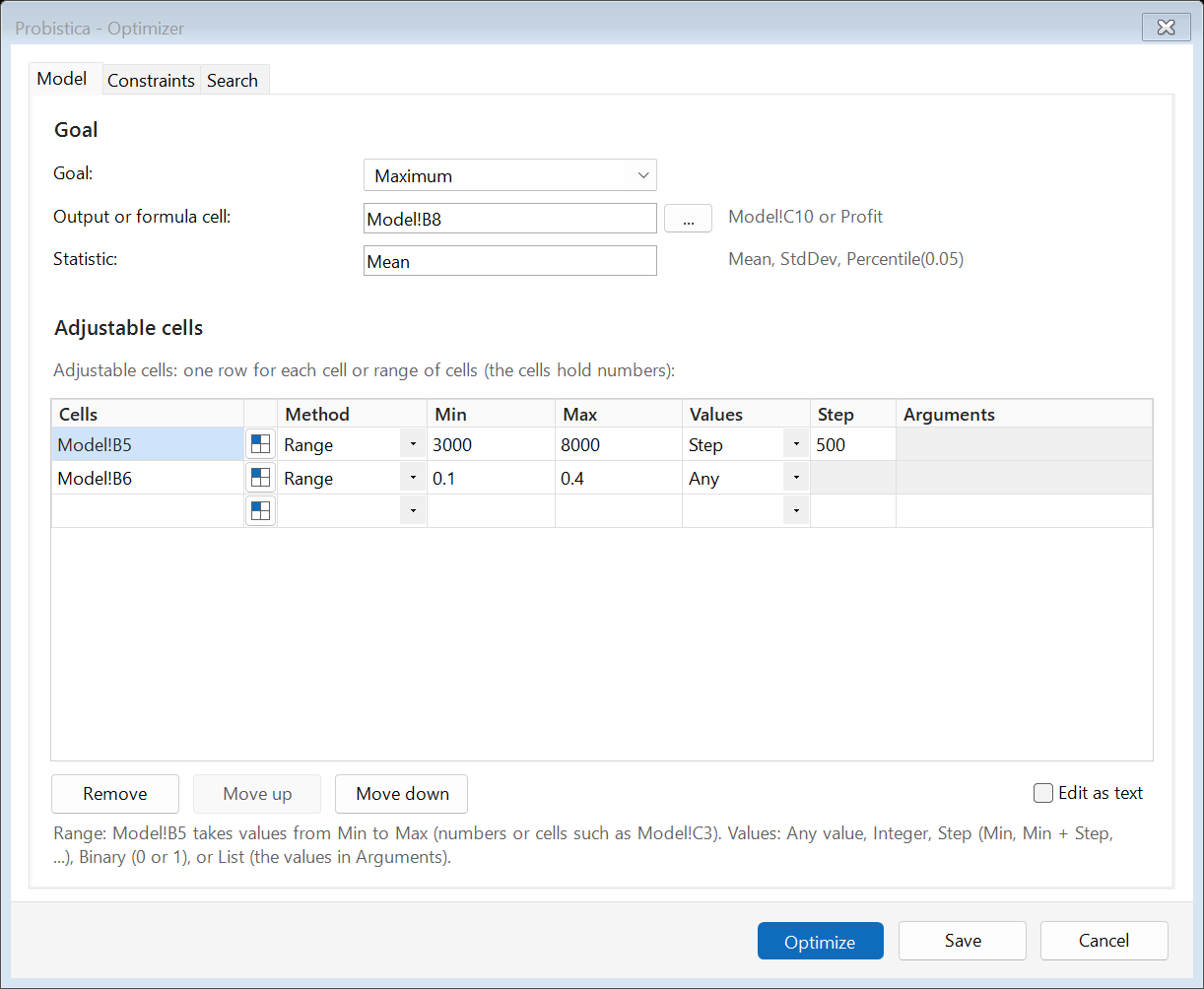
Choose the goal (maximum, minimum, or a target), the output, and the statistic, for example the mean or the 5th percentile. Add the adjustable cells with their limits.
- Ranges with any value, integers, a step, a choice of 0 or 1, or a list of values.
- Orders, groupings, task orders that keep the required predecessors, and tasks in time blocks.
- Limits can come from cells.
Search engines
Automatic selects the method for your model. The engine Surrogate learns a model of the goal and of each side of each hard constraint from the simulations with usable results. It does not learn from a simulation with an error value, or from one that stopped at a trial that breaks a constraint. The penalties of soft constraints go into the score of the goal. A pattern search, an evolution strategy, and a genetic algorithm are also available.
Exact method for linear models
When the goal and the constraints are linear in the decision cells, Probistica finds the linear model with a small number of simulations. A linear or mixed-integer solver then gives the solution and the bound of the solver. A linear program without integer variables that has a solution also gives shadow prices. A shadow price is a local rate for a bound of the linear program that Probistica solved. At a corner, a rate can apply in only one direction. If the solve cannot show a rate, the sheet gives a reason in place of the price. For a percentile limit on the safe side, it is the price of the stricter limit. A mixed-integer model and a model without a solution have no prices. The method can also end with a gap to the bound or with no solution, and the result sheet tells why. When the method does not apply, Automatic gives the reason on its result sheet, if it writes one. Automatic can then search, if a simulation of your maximum is left and a stopping rule permits it. The engine Exact then stops with a message that gives the reason, and it writes no sheet.
Risk limits
Limit the mean of the worst trials, the worst trial, or a percentile, for example "the mean of the worst 5 percent of the profit is -1000 or more". For a model that is linear in each trial, the exact method puts these limits on the trials, for the statistics and the limit directions that it takes. A percentile limit can need binary variables. When the percentile limits of the model together need more than 200 of them, the exact method solves a stricter limit (the safe side): the solution meets your percentile limit on the trials of the model, but the run does not show that it is the optimum of your problem. The number of trials alone does not decide this: an upper limit on the largest trial, or a lower limit on the smallest trial, needs no binary variable.
Constraints
Hard and soft constraints on output statistics or on formula cells, for example "the 5th percentile of profit is 0 or more". A soft constraint takes a penalty.
Budgets and frontiers
Keep the total of a group of cells fixed. Run one optimization for each bound to draw an efficient frontier.
Optimizer Watcher
Watch the progress, the log, and the population. Pause, resume, or stop the search. Set a time limit or a progress rule.
The best solution of a search is the best that the search found. It is not a proven optimum. When the result sheet of the exact method says "an optimum of the linear model within a tolerance", that is true for the linear model and for the random numbers of the seed. The result sheet shows the result with the next seed, so that you can check it. With Monte Carlo sampling and two or more trials, the sheet also gives the standard error of the mean, the standard deviation, the variance, and most percentiles. For a percentile at or near the smallest or the largest trial, the standard error is 0 only when Probistica can show that the trials of the output do not change with the seed. The output must read no distribution. When the output reads the number of the trial or a convergence level, and the model has a distribution, the model must also have no stop of the simulation, and each convergence level of the model must follow an output that reads no distribution. The standard error is not available for each other output. For the other statistics and for Latin Hypercube sampling, the standard error is not available. A trial solution of one recalculation has the standard error 0 with each sampling method.